V THE FIRST
BESTIARY

THE BESTIARY
by Lord D.
Where Monsters Are Named,
and Legends Become Flesh.
Bound in timeworn leather and secured by a fading clasp of bronze, this ancient scroll-book is known as “The Bestiary.” Within its brittle vellum leaves are set down the creatures of the unseen world—their breeds, their lineage traced unbroken to the primal matriarch, the All-Mother.
The script is rendered in a lost alphabet, a tongue of curled sigils and silent strokes. Across those pages we find the measured hand of Lord Darius von Croÿ, whose words remain as steady as the ink that binds them to the page:
“Most of the unseen born to the All-Mother dwelt not in flesh but in the ethereal reaches beyond the Veil—beings of thought and pulse, shaped of the Mother’s own emotions. Mortals called them demons, but the truer word is daemons. They were neither wholly good nor wholly wicked; they simply were, as tides are, rising and receding with her moods.”
*“Then came the Light. And with it came humanity—though few remember that there were once other human races, as ancient as the earth itself. Nature compelled them to contend, until only one lineage endured.
In that age, after the rise of humankind, the first true Children of the Night were born of the All-Mother’s womb. Many took the guise of mortals, though some bore shapes that defied the eye, and even those who looked like men and women wielded the powers once reserved for gods.”*
“Ages turned. The Children of the Night, like humankind, grew numerous. They bred among their own and sometimes with mortals, and so the divine blood of the All-Mother thinned, splintering into tribes and races—each branch a shadow of the first matriarch’s might.”
THE TRIBES
The Creatures of the Garden

Creatures & Beings
We might look like you,
But we are not
The hidden world possesses its own order, governed not by superstition or chance, but by ancient laws that have endured since the first dawn of Creation. Its inhabitants are neither random marvels nor simple horrors, but distinct races, spirits, and beings, each shaped by origins, instincts, and destinies as intricate as those of humanity itself. To dismiss them collectively as monsters is to misunderstand both their nature and the delicate balance they have maintained with the mortal realm since time beyond memory.
The Bestiary presents a systematic account of the known peoples and extraordinary creatures whose existence has been preserved through royal chronicles, ecclesiastical archives, forgotten grimoires, noble libraries, and oral traditions spanning countless generations. Each entry examines their origins, physical form, nature, society, abilities, limitations, and influence upon history, seeking not to inspire fear or admiration, but understanding.
Though many of these beings have been reduced to folklore, condemned as demons, or exalted as gods, few are so easily defined. Some have guarded mankind from unseen evils, others have preyed upon civilizations from the shadows, while many have simply endured the passing of ages according to laws older than kingdoms, faiths, and empires. Their histories are woven into the rise and fall of nations, their footprints lingering wherever myth and history become indistinguishable.
For throughout the centuries, ignorance has proven more perilous than any creature described within these pages. To study the hidden races is to glimpse the greater design of Creation itself—a world in which humanity has never stood alone, but has always shared the earth with countless others, each bearing its own place within the unseen order of existence.
WHAT
Races, Tribes & Entities

Humans

Daemons

Incubus

Lycans

Nymphs

Witches

The Fallen

Cambions

Shifters

Jinns

Warloks

Sucubus

Revenants

Dragons

Ghouls
Humanity
Humans
Those who inherited the world
The dominant species over the face of the planet, one may say without hesitation.
But, do they sit at the top of the food chain?
They might not be the mightiest, yet they have the numbers, and they can endure across millennia despite their meaningless, fleeting lives.
But then again, they do leave behind legacies that reverberate beyond their life and for countless generations.
Who sits at the top?

Witches
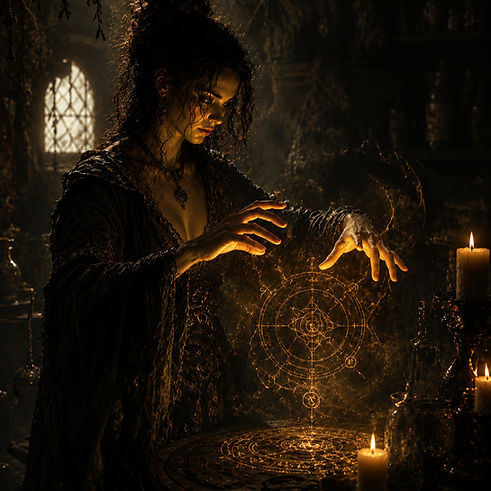
Witches
They do not command Nature.
They speak its language.
Witches are the daughters of the Old Blood, a matrilineal people whose power arises not from dominion over Nature but from communion with it. Their arts flow through ancestral bloodlines and manifest through earth, water, wind, fire, the stars, and the unseen forces woven between them. They are among the most human of the Children of the Unseen, yet within their blood sleeps an inheritance older than kingdoms: a living memory of the world before men learned to name its mysteries.
Warlock
Warlock
The blood that gives them power demands a price.
Warlocks are a separate Genos from witches, though both descend from an ancient and disputed ancestry. Marked by the blood of Cain, they are solitary, territorial, and predatory, drawing power not through communion but through will, ritual, and the consumption of their own kind. Fire and Air answer most readily to them, but their greatest gift is also their curse: power must grow, and growth demands a price. Every warlock eventually becomes hunter or hunted, often both, for the blood that gives him strength also teaches him to fear the strength of another.

Daemons

Daemons
Every emotion and every thought of the All-Mother could become a life of its own
Contrary to similar entities known as the Fallen, daemons are creatures of darkness from the darkest corners of the other side of the veil.
They are conscious manifestations of the All-Mother's thoughts, emotions, impulses, and primordial faculties, given independent existence beyond the Veil. though some embody impulses that mortals experience as terrifying, destructive, or forbidden, yet it is what they need to exist and survive, like Incubi and succubi, which feed on the energetic and bodily emissions associated with human’ lust and desire. There are others that may feed on fear, pain, shame, chaos or madness.
There are countless other disembodied entities that belong to this vast and poorly understood order, existing in a realm where thought itself may become flesh, hunger, memory, or will.
Fallen
Fallen
They did not come from the darkness.They fell into it.
The Fallen are not Daemons, nor are they Children of the Unseen in the same sense. They were once Divine beings—Angels, Watchers, and other servants of the celestial order—who possessed their own nature, purpose, and place within Creation before their fall. Where Daemons arose from the All-Mother's thoughts, emotions, and primordial impulses given independent consciousness beyond the Veil, the Fallen were fashioned as agents of a higher divine order and possessed knowledge and authority that preceded the mortal world. Their fall did not make them Daemons; it severed them from the order they once served. Some became corrupted by pride, desire, knowledge, or rebellion, while others fell through acts whose reasons have been lost to history. They retained fragments of their former power, but stripped of divine purpose, that power became something more dangerous: authority without allegiance, immortality without sanctuary, and knowledge without the wisdom of the order that gave it meaning.


Sucubus

Sucubus
She enters the dream as desire, and leaves behind a question.
A Succubus is the feminine manifestation of the Oneiroi Daemon, dwelling at the threshold between dream and waking where desire is most easily mistaken for one's own thought. Like the Incubus, it is neither virtuous nor wicked by its essential nature; it is a creature governed by instinct, drawn toward human vitality, passion, breath, and the subtle essence released by intimacy. Across ages and cultures, mortal traditions have given the Succubus countless faces—seductress, night spirit, demon, enchantress, or forbidden lover—but beneath these interpretations lies the same ancient nature: an entity without permanent flesh seeking sustenance from those who possess it. Unlike the Incubus, however, the Succubus may spend centuries pressing against the boundary of corporeal existence before her essence can become sufficiently anchored to produce flesh of her own. When that process succeeds through a woman of the Old Blood, the resulting Cambion may inherit something of the Succubus's affinity for desire, illusion, and the unseen currents of the mind. Thus the Succubus is not simply a creature that visits the dreams of mortals; she is a being forever standing between what is imagined and what can become real.
Incubus
Incubus
It does not come when you sleep. It comes because you do.
An Incubus is an Oneiroi Daemon, a disembodied Child of the Unseen whose nature is bound to sleep, dreams, desire, and the exchange of vital essence. Neither benevolent nor malevolent by nature, it follows the necessities of its own existence rather than the moral laws imposed by mortals; it enters dreams, kindles longing, and draws sustenance from the warmth, breath, and essence released through intimacy. Ancient peoples understood such visitations long before priests gave them the language of sin, remembering them as spirits of the night, dream-walkers, or lovers from beyond the veil; later religions gathered these traditions beneath the name of demon and temptation. The Incubus itself is less concerned with such distinctions. It seeks what its nature requires, and where desire opens a passage between dream and flesh, it follows. On rare occasions, particularly with women of the Old Blood, its presence may endure beyond the dream and take root within the mortal body, slowly pressing an incorporeal existence toward flesh. From such unions may come the forbidden Cambion, though whether this is an act of creation or merely possession given blood remains a question no living scholar has answered.


Cambion
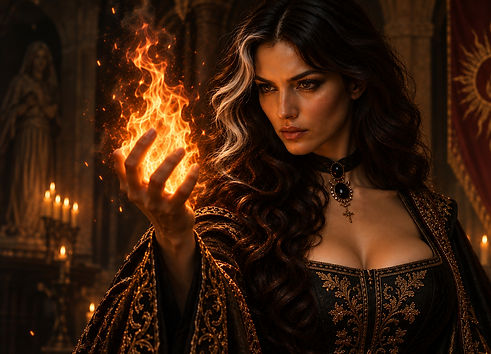
Cambion
Something from beyond the Veil learned how to wear flesh
Cambions are the embodied consequences of a breach between worlds: vessels of the Old Blood through which disembodied entities born beyond the Veil acquire flesh and consciousness in the material realm. They are neither demon nor mortal, neither witch nor revenant, and belong fully to none of the orders that govern the Unseen. Often possessed of extraordinary beauty, an affinity for Fire, and an almost intoxicating influence over desire, they can inspire obsession, decadence, and madness merely by their presence. Their true potential remains unknown, for the world has rarely permitted one to survive long enough to discover it.
Shifters
Shifters
Every face is a mask.
Every name is temporary.
Shifters are less a recognized Genos than a phenomenon observed among certain Children of the Unseen: beings capable of altering their appearance, identity, and perhaps even aspects of their nature so completely that no reliable account of their true form has ever survived. Their origins remain unknown, for every attempt to trace a Shifter through bloodline, history, or place eventually ends in contradiction; when discovered, they simply become someone else. Some may change only their face and voice, while older accounts suggest that the most accomplished can assume another person's mannerisms, memories, habits, and station with unsettling precision. Whether this is transformation, illusion, possession, or something more fundamental has never been established. Thus Shifter is best understood not as a species, but as a quality—a capacity to abandon one identity and assume another. There may be no Shifter race at all, only creatures whose true nature has remained hidden because they have never allowed the world to see it twice.

Lycans

Lycans
They were never men who became wolves. They were both.
Lycans, also known as Werewolves, are the ancient Therianthropoi of the Wolf-Blood, beings in whom human reason and the primal spirit of the wolf exist in a single, formidable nature. Once counted among the highest orders of the Revenants, the Lycans too descended from the All-Mother and, in ages long forgotten, held dominion over vast territories of the Unseen Realm. They were organized according to the ancient laws of the wolf pack, ruled by male and female Alphas, and bound to one another by fierce, lifelong bonds of blood and kinship; yet, as among wolves themselves, there were always those who walked alone—the Omegas, solitary creatures often marked by mysterious origins, exile, or tragic fate. Though not immortal, Lycans age with extraordinary slowness and possess immense regenerative power, making them among the most resilient beings of the Unseen World. Their oldest and most natural adversaries are the Revenants, who surpass them in strength but are themselves burdened by ancient limitations, chief among them the sleep of ages and the curse of sunlight. The Great War of the Underworld brought the Lycans to the brink of extinction, leaving their once-mighty bloodline scattered and nearly forgotten. Yet the oldest prophecy spoke of a return: the emergence of a new specimen, born of the ancient Wolf-Blood, who would restore the Lycan lineage—and, in doing so, bring ruin upon the Lords of the Revenants.


Revenant
Revenant
Time does not kill them. It takes everything else.
The Revenants are the deathless Children of the Unseen, once human, now sustained by the Black Blood of the All-Mother. Neither wholly dead nor truly alive, they are creatures of night whose bodies escape decay while their humanity slowly erodes beneath the weight of centuries. Their society is governed by blood, hierarchy, and permanence, and their greatest weapon is not strength but time—the ability to remember what others forget, wait while kingdoms rise and fall, and quietly shape the world toward their own survival.

Dragon

Dragon
They are not beasts of legend.
Legend is what remains when they left
Dragons are among the oldest and most formidable of the Children of the Unseen, primordial beings whose existence predates the kingdoms of men and whose nature seems to stand at the boundary between beast, spirit, and elemental force. Ancient traditions disagree upon their origin, but most agree that dragons were fashioned in the earliest ordering of the world, when the powers of the elements had not yet been fully separated from living form. They possess immense intelligence, extraordinary longevity, and an affinity with the primordial forces of Nature, most commonly Fire, though other elemental expressions have been recorded. Unlike the Revenants, they do not seek dominion; unlike the Daemons, they are not embodiments of thought or emotion; and unlike the Therianthropoi, they do not pass between human and animal forms. Dragons are complete unto themselves—ancient, territorial, immensely powerful, and largely indifferent to the affairs of lesser beings. Their rarity in the present age is therefore not evidence of extinction, but perhaps of withdrawal; some scholars maintain that the oldest dragons simply learned that the world is safest when it does not know where they sleep.
Nymphs
Nymphs
Where nature speak, the Nymph remembers its voice.
Nymphs are ancient minor deities, yet included amongst the Children of the Unseen, whose existence is inseparable from the living places they inhabit. They are not merely spirits of nature, nor are they witches who have learned to command its forces; rather, they are manifestations of Nature given conscious form, each bound by affinity to a particular landscape, element, or living domain. Forest, river, spring, mountain, grove, and meadow may each sustain its own kind, and the temperament of the nymph often reflects the nature of the place that gave her being. They possess an instinctive communion with plants, animals, water, weather, and the subtle rhythms of the earth, and may endure for as long as their domain remains alive. Beautiful by nature and often mistaken for mortal women, nymphs are neither benevolent nor cruel by design; their loyalties are to the places and forces they embody. To protect their domain, they may nurture, seduce, deceive, or destroy with equal ease. Their greatest mystery is also their simplest truth: where a nymph dwells, the land itself may be watching.

Jinns

Jinn
They are neither gods nor demons, but something older than both names.
The Jinn are among the eldest of the Children of the Unseen, born of smokeless flame before mankind was given form and before the boundaries between the worlds were fully sealed. Neither gods nor demons, they are an ancient people unto themselves, possessing kingdoms, laws, bloodlines, loyalties, and rivalries that have endured beyond the memory of men. Their nature is bound to flame, breath, desert wind, and the unseen currents that pass between realms, granting them the rare ability to cross where mortal feet cannot tread and to assume forms both wondrous and terrible. They are creatures of thought as much as fire, capable of shaping the world through will, illusion, and desire, and even the wisest among the Children of the Unseen have long regarded them with caution. Some are keepers of ancient knowledge, guardians of sacred places, and allies to those who honor the old laws; others are driven by pride, passion, vengeance, or an appetite for power that has no mortal measure. The Jinn are neither inherently benevolent nor wicked, for their kind is divided by allegiance, element, and ancient purpose rather than any simple doctrine of good or evil. Their oldest chronicles speak of ages forgotten even by the elder races of mankind, and of wars fought before human kingdoms had names. Thus the Jinn remain what they have always been: a people of the flame between worlds, neither bound to Heaven nor condemned to Darkness, whose favor may illuminate a life and whose wrath may consume one.
Ghouls
Ghouls
Where the dead are forgotten,
the ghouls remember.
Ghouls are among the darker and more degraded inhabitants of the Unseen, creatures whose existence is intimately bound to death, carrion, and the places where the dead are forgotten. Unlike Revenants, they are not restored humans sustained by the Black Blood, nor are they spirits returned to inhabit the flesh; they are corporeal creatures whose nature has become adapted to the consumption of the dead. They haunt burial grounds, abandoned settlements, battlefields, and places where the boundary between the living and the dead has grown thin, possessing an intelligence sufficient for language, deception, and rudimentary organization, though their instincts remain dominated by hunger. Some traditions claim that ghouls were once mortal beings transformed by prolonged contact with death, while others describe them as an older species that merely learned to follow humanity into its graveyards. Whatever their origin, they occupy an unsettling place within the natural order: they do not kill because they hate the living, but because death itself is their sustenance, and wherever civilization leaves its dead, the ghouls are never far behind.

Familiars

Familiars
Where Her Shadow Falls,
Another Moves
It is whispered in the oldest chronicles that no witch who walks the old paths walks alone. Where her shadow falls, another may move beside it—not bound by chain or collar, but by pact. These are the Familiars, spirits of the Unseen clothed in the forms of beasts: cat, crow, serpent, hound, spider, owl, and stranger things yet. They are no mere animals, but beings of will, memory, desire, and secret knowledge. To a witch, a Familiar may be companion, guardian, messenger, or spy, lending its senses and power while perceiving what mortal eyes cannot. Yet every pact demands its due—blood, memory, vitality, or, in the darkest bindings, the soul itself. Thus the Codex warns: the Familiar is never merely a servant. As the bond deepens, witch and beast may become so entwined that neither master nor servant can be named. Where you see the beast, beware the mistress; where you see the mistress, beware the beast.
COVENS
When they gather the wrold trembles

A Coven is the living heart of the Old Ways, a fellowship of witches united not simply by the practice of magic, but by an unbroken covenant of memory, reverence, and sacred tradition. Within the shelter of forgotten sanctuaries, where beeswax candles cast golden light upon worn leather tomes and ancient stones echo with whispered invocations, elders pass their hard-won wisdom to those chosen to continue the lineage. Under the watchful guidance of a matriarch, apprentices learn the rites of the seasons, the hidden virtues of root and herb, and the silent laws that bind the visible world to realms beyond mortal sight. Far from the kingdoms of men, covens flourish in secluded forests, forgotten valleys, and quiet villages where the veil between worlds grows thin, serving as steadfast custodians of mysteries that have endured since the dawn of memory. For while empires are raised and reduced to dust, the circles of the witches are broken only when the earth itself forgets their names.

Scarlet

The Romas

Sisterhoods
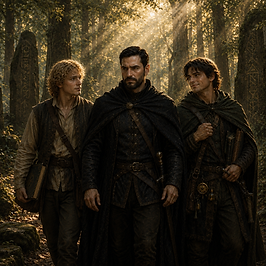
The Abelian Tryad

The Brotherhoods

The Canian Tryads
CLANS & COURTS
When they gather the wrold trembles
Not all beings assemble in covens, for there is no universal brotherhood or sisterhood among the hidden races. Many possess neither the shared purpose nor the sacred bonds that compel witches and warlocks to gather beneath a common tradition. Instead, their alliances arise from altogether different impulses: blood, instinct, dominion, survival, ambition, devotion, or the irresistible authority of a stronger will.
Accordingly, each race has developed forms of society that reflect its own nature. Some unite as packs, bound by kinship and primal hierarchy. Others dwell within nests, where lineage and propagation take precedence over all else. Certain spirits gather as hosts, acting in solemn service to a common purpose, while celestial beings may be known collectively as choirs, ordered according to ancient harmonies beyond mortal understanding. Still others march as legions, forged through conquest, discipline, and unwavering obedience to their commanders.
These varied assemblies are more than names; they are reflections of the fundamental character of the beings who compose them. To understand the manner in which a creature gathers with its own kind is often to understand the very essence of its existence.

Revenant Nests

Lycan Packs

Hosts

Revenant Courts

Choir

Legion
CONSILUIM
The Great Gathering

THE PACT
It came to pass that the mightiest and wisest among the races of the Unseen were summoned to a single gathering. Alphas, Elders, Supremes, Lords, and Masters crossed ancient boundaries and assembled in council to deliberate upon the laws that would govern the Unseen Realm.
There, they studied, disputed, and negotiated the ancient laws by which clans and tribes might coexist—not always in peace, but in civilization. Their foremost purpose was to preserve the secrecy of their existence from mankind, through cooperation where wisdom prevailed, and through the strict observance of boundaries, territories, and sacred hunting grounds where it did not.
From these deliberations was forged a body of laws, solemnly recorded and forever enshrined in what came to be known as the Sacred Canon.
Thus was born the Consilium of the Unseen.
For millennia, its laws held.
And for millennia, the fragile peace and ancient balance among the creatures of the Unseen endured. Territories were respected. Hunting grounds were guarded. Old rivalries were contained. The existence of the Unseen remained concealed from mankind.
Until it did not.
And there was war.


