WHAT:
CAMBIONS

ABOUT
CAMBIONS
From a mother of the old blood,
And something darker as a father,
Entities from the other side
find their way into our world.
Cambions are for bidden by the law of men the divine,
but also by Sacre Canon of the underwold.
Cambions are not born of sin or desire, but of collapse. They emerge where ancient boundaries fail—where laws once thought immutable no longer hold. Neither demon nor mortal, neither witch nor revenant, they obey no hierarchy and inherit no allegiance. Power does not answer them; it gathers. Their existence is not a warning of what may come, but evidence of what has already occurred: the quiet dissolution of order beneath the world’s surface.


CAMBIONS
On the nature of...
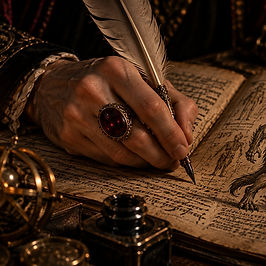
On the Nature

The First Cambion

The Beast of Babylon

The Scarlet

The Prophecy

The Middle Head
On the Nature of
CAMBIONS
Canbions are the offspring of a person of the old blood and a demon, most often an incubus or succubus. These creatures are often described as having demonic and human characteristics, sometimes with inherent magical abilities. Cambions often possess innate magical abilities, sometimes linked to their demonic heritage, like affinity for void magic or resistance to other types of magic.
The conception of a cambion is a rarity, for it demands more than a single act of union. It requires the relentless persistence of a being born from beyond the veil, pressing again and again against the fabric of the mortal plane until its essence takes hold. To fashion flesh from shadow is no simple thing.
Witches, however, stand as the most willing vessels. Their bodies, attuned to both the natural and the arcane, become the bridges through which such forbidden offspring may pass into the world. Thus the cambion is born — not merely of man or demon, but of a union between flesh and the immaterial, blood and dream, spell and hunger.
According to the Sacred Canons, the birth of a cambion was a blasphemy. Their very presence in the material world — where mortals and creatures alike drew breath — was said to invite calamity. Wherever they walked, chaos followed: lands withered, covens fractured, kingdoms bled. Thus, the decree was absolute. Cambions were abominations to be destroyed at birth, lest both realms suffer their curse.
Yet in the early 13th century, the order was broken. The Revenant Overlords, arbiters of shadow and blood, pronounced a new law. No longer would cambions be killed in the cradle. They would be permitted to live. More than that — it seemed they were being bred with purpose. No accident of sin or sorcery, but deliberate design.
I
The Cambion Primordium
The demon is ancient. The vessel is mortal.
The Cambion is what happens when
the two worlds fail to remain separate.
A Cambion is the first known manifestation of a being from beyond the Veil successfully incarnating within a vessel ofThe Cambion Primordium was the first entity from beyond the Veil to successfully incarnate through the Old Blood. Its nature was neither wholly demonic nor wholly draconic. It was something older, possessing qualities of both. Every Cambion born thereafter carries, however distantly, the echo of that first crossing.the Old Blood, establishing the condition from which all subsequent Cambions descend.
II
The Cambions Physis
Cambions are Children of the Unseen, though they occupy a singular and troubling position among them. They are neither wholly creatures of the material world nor proper inhabitants of that which lies beyond the Veil. They emerge where the boundary between those realms has failed sufficiently for something disembodied to acquire flesh. For this reason, I have found the common designation of half-demon inadequate. A Cambion is not merely the offspring of two different natures. It is the consequence of two orders of existence becoming entangled.
Their existence is therefore less a matter of genealogy than of intrusion. A Cambion is born when something that should have remained without flesh finds a vessel through which it may enter the world.
III
The Cambions Genos
Cambions are the offspring of a person of the Old Blood and an entity from beyond the Veil, most commonly an incubus or succubus. The conception is exceedingly rare, for it requires more than the union of flesh. The disembodied entity must persist against the boundary separating the worlds, pressing its essence into the material realm until that essence takes root within a living vessel.
Witches appear to be the most suitable vessels. Their bodies are already attuned to forces both natural and arcane, and their blood possesses qualities that permit what is immaterial to establish itself within the material. The resulting child develops as any human child might. The entity remains dormant within the subconscious, often concealed even from the child herself. What is born, therefore, appears human long before it reveals what else it contains.
IV
The Cambions Ethnos
Cambions do not constitute a people in the ordinary sense. They have no common homeland, language, or civilization, and their appearances may differ according to the human blood from which they arise. Yet they display certain recurring characteristics across cultures and generations, suggesting that the nature of the entity within them exerts greater influence than geography.
Most recorded Cambions have been female, and many possess an extraordinary beauty that appears almost deliberately fashioned to attract human attention. This should not be mistaken for vanity of nature. Seduction is among the oldest instruments through which beings from beyond the Veil have interacted with the mortal world.
V
The Cambions Oikos
Oikos Cambions do not inherit conventional houses in the manner of Revenants, nor do they possess the stable bloodline structures of witches. Their true lineage is the entity that inhabits them, and that lineage may remain unknown even to the Cambion herself.
Female Cambions, however, possess a curious tendency to find one another. Drawn together by forces that cannot easily be observed or explained, they may form covens or sisterhoods. Whether these gatherings represent affection, instinct, or some deeper communion between the entities within them remains uncertain.
VI
The Cambions Archē
Cambions possess no recognized Archē.
This is not an omission in their classification but a consequence of their nature. They do not inherit a lawful station within the hierarchies of the Unseen, and no established order has ever succeeded in placing them beneath its authority. Their power does not appear to increase according to rank, title, or genealogy in the manner of the Revenants.
There are, nevertheless, Cambions whose power exceeds that of their kind. Such individuals may become natural centers of authority among other Cambions and are sometimes called Alphas. The title is descriptive rather than hereditary. Talyssa Dalca, for example, is regarded as an Alpha Cambion—a queen among her kind by presence and influence rather than by any recognized throne.
VII
The Cambions Traditio
Cambions possess no singular magical tradition. Their abilities appear to emerge from the nature of the entity dwelling within them and may manifest without instruction, warning, or precedent. Fire is the most commonly observed affinity, but individual Cambions may exhibit abilities unlike those recorded in any other member of their Genos. They are therefore poor students of conventional magic but extraordinary vessels for power. A witch learns her Art. A warlock cultivates his. A Cambion may simply awaken one morning to discover that something within her has learned it for her.
VIII
The Cambions Temperament
The Cambion is not naturally obedient to the structures governing mortal society, the divine orders, or the hierarchies of the Underworld. It belongs fully to none of them and therefore recognizes none as inherently binding. This does not make every Cambion malicious, but it makes them exceptionally difficult to predict, contain, or govern.
Their presence is frequently accompanied by heightened desire, weakened restraint, and an atmosphere of decadence. They may provoke fascination, obsession, jealousy, lust, or irrational devotion without consciously intending to do so. The distinction between deliberate seduction and an involuntary manifestation of their nature is often impossible to determine.
IX
The Cambions Gifts
The Cambion's most notable gift is its ability to influence desire. They are often extraordinarily seductive, and prolonged exposure to one may produce an attachment bordering upon obsession. Men in particular may become so consumed by their desire that reason, morality, and self-preservation cease to function. Cambions feed upon the energies associated with intimacy: the seed of men, the fluids exchanged between lovers, and the breath of a lover. Such feeding is not necessarily an act of malice, although it may become fatal. Their elemental affinity with Fire is common, but each Cambion may develop other powers that appear to originate from the entity within rather than from any known school of magic.
X
The Cambions Weaknesses
The principal weakness of the Cambion is the same circumstance that makes its existence possible: it does not entirely belong to the material world. The body is a vessel, and the presence within it may be restrained through ancient sigils. Gold and silver ornaments inscribed with particular symbols have been used to bind or suppress Cambion abilities, often sewn directly into their garments.
Historically, however, the greatest threat to Cambions has been neither silver nor magic, but other beings. They have been hunted from the moment of their discovery and frequently destroyed before birth or immediately afterward. Consequently, almost no Cambion has been permitted to reach the full maturity of her potential. We therefore do not know the upper limit of their power. What we call their gifts may be no more than the earliest signs of what they could become.
XI
The Cambions Society
Cambions have never been permitted to establish an enduring society of their own. For most of recorded history, the law of men, the divine order, and the Sacred Canons of the Underworld all agreed upon their destruction. They were considered abominations whose existence itself threatened the boundary between worlds.
Yet the female Cambions that survived often found refuge among witches. Elder covens and sisterhoods sometimes concealed them, believing them to be unusually gifted witches until their true nature became apparent. Such protection was not always deliberate; many Cambions were raised within witch communities before anyone understood what had been born among them.
XII
The Cambions Relations
Few Children of the Unseen have been regarded with such universal suspicion. Revenants consider Cambions unpredictable. Warlocks regard them with a mixture of fascination and distrust. Witches have alternated between sheltering them, studying them, and fearing what their presence might attract. The divine orders have traditionally regarded them as violations of the boundaries of Creation itself.
The Sacred Canons therefore prohibited their existence, and for centuries their destruction was sanctioned. This changed in the early thirteenth century when the Revenant Overlords abolished the ancient decree and permitted Cambions to live. The decision remains one of the great political mysteries of the Unseen Realm, particularly because subsequent evidence suggests that Cambions were not merely spared, but may have been deliberately preserved—or even bred—with a purpose that remains undisclosed.
Rosetta

Rosetta di Verona
Supreme of the Eternal Flame
Lady Rosetta di Verona was the first cambion permitted to live in countless generations, her very existence a defiance of ancient laws that had long condemned her kind as abominations in both the mortal and unseen realms.
Born of an unholy union between an incubus and a girl of witch blood, she was hidden away and raised in secrecy by the Sisterhood of the Eternal, a coven bound to elemental vows.
Though mistrusted and feared even among her guardians, Rosetta bore their suspicion with quiet resolve, and in time revealed a gift unmatched by any of her sisters. The elements bent to her command—most of all fire, which seemed to acknowledge her as its rightful sovereign. Upon the death of the High Priestess, Rosetta rose as her successor, a formidable leader who inspired not only obedience but awe.
WHAT:
DRAGONS

They Were Not Myth.
They Were Memory.
Across the oldest traditions of the world, dragons appear beneath countless names and forms: the great serpents of Mesopotamia, the "tannîn" and Leviathan of Hebrew scripture, the "drakōn" of the Greeks, Fáfnir of the Northern sagas, the celestial dragons of China, and the monstrous guardians remembered in medieval chronicles. Some were said to command fire, others water, storms, or the very forces of nature; some guarded sacred places and treasures, while others embodied chaos, destruction, and primordial power. Whether these accounts arose from encounters with creatures now forgotten, distorted memories of something that once walked the material plane, or visions of beings from beyond the veil remains unknown. Yet in the unseen world, there is no uncertainty: "dragons are real." They endure beyond the veil, ancient and immense, in realms where the laws governing mortal existence do not wholly apply. Whatever their origins, they were eventually vanished from the mortal world. The great beasts disappeared, one after another, while those few that remained were hunted by men, destroyed by the servants of the divine, or simply died out until dragons became nothing more than echoes preserved in myth.
And yet, perhaps the oldest secret of the dragon has never been fully understood. What if the creatures once called dragons were not entirely separate from the beings later known as "Cambions"?
What if, rather than beasts, some dragons possessed the ability to cross the boundary between worlds by taking mortal form? Among the oldest fragments of Babylonian memory lies the image of a monstrous "seven-headed dragon", a creature of such terrible antiquity that its shadow may have survived even into the sacred traditions of the Bible. Perhaps it did not perish with the ancient world. Perhaps it found its way into the mortal realm once more—not as one creature, but as "seven young women of peerless beauty, each bearing within her the essence of one of its seven heads."
If so, the Cambions may not merely descend from dragons. **They may be dragons themselves, incarnated in human form.**
THE SCARLET
The Beast of Babylon

THE SCARLET
The Beast of Babylon
Scarlet, that colour seems to taint the air in every room they inhabit.
Many things have been said about them.
Ladies, Harlots, demons.
The Scarlet Maidens.
Other things were told also, many centuries earlier.
Revelation 17
The Bible
The Vision (Verses 1–6):
One of the angels with the seven bowls invites the Apostle John to witness the judgment of the "great prostitute" who sits on many waters. John is carried into the wilderness where he sees a woman clothed in purple and scarlet, adorned with gold and jewels. She rides a scarlet beast with seven heads and ten horns. She holds a golden cup full of abominations and is drunk on the blood of Christian martyrs.

There are Prophecies written in forgotten tongue,
only spoken in the hush of ancient temples.
There are the prophecies of men,
And there are prophecies kept by creatures.
But some prophecies are shared by both worlds.
The Scarlet,
Also known as The Beast of Babylon.
Revelation 17 in the Bible is recorded in
a seven head dragon that had been trying to find its way into the world that mankind and creatures share.


In the year 1315 a girl was born to a Romani girl and a redhead noble boy in Bohemia.
Her name was Talysse,
She was only one of seven.
A Red Castle and a throne
have been waiting for ages.


Waiting for the return
of the Dragon of Babylon
THE BEAST
The Seven Heads of the Red Dragon

Talysse

Ragnhild

Lin Xiu

Sundari

Polissena

Anica & Dragana
TALYSSE
The Head in the Middle

Talysse Baudelaire
Supreme of the Scarlet Maides
Talysse, a Cambion born of a witch and an incubus inhabiting the corpse of her noble father, was destined from birth to embody forbidden desire and calamity. With her fiery red hair, pale skin, and piercing emerald eyes, she was both captivating and feared, her existence marked as an abomination by the witches of the South Watchtower, where she was raised under suspicion and scorn. Protected by the demonic essence that sired her, she survived even an attempt on her life as an infant and grew into a child of unnerving power. In her early teens, after gazing into the Eye of Cassandra and glimpsing a fate she could not accept, she fled the coven and sought refuge at the infamous Red Castle, where Madame Baudelaire—the last of the Nymphs—became her mentor. Under the Nymph’s tutelage, Talysse mastered the arts of seduction, manipulation, and power, ultimately surpassing her teacher and claiming her name, fortune, and the Red Castle itself.
As the new Madame Baudelaire, Talysse forged the Scarlet Maiden, a coven of Cambions whose influence rivaled even the four great Elemental Covens. She walked the courts of Europe, leaving trails of scandal in her wake, and consolidated her strength until the awakening of the All-Mother summoned all Children of the Night to perform the Final Rite. Defiant and irreverent, Talysse refused to take part, and the rite collapsed into catastrophe, unraveling the underworld and unleashing a menace that hunted witches into near extinction. Fleeing with the Scarlet Maiden, Talysse sought refuge in the town of Targos beneath the looming Basarab Castle. Though she had survived the fall of covens and the ruin of the old order, she knew her part in the greater design was far from over, for destiny had marked her as both a survivor and a player in the storms yet to come.
Scarlet 2

Lin Xiu
The Wisper
Born in the imperial world of China on the same night as Talysse, the second Maiden grows up thousands of miles from Provence, surrounded by a civilization whose sophistication, traditions, scholarship, and strict social order are completely foreign to the world Talysse knows. Her childhood is shaped by discipline, etiquette, family obligation, learning, and an acute awareness of what is spoken and what must remain unspoken. From an early age she discovers that people respond strangely to her voice: secrets emerge in her presence, arguments quiet when she speaks, and dreams sometimes carry her words into the minds of others. She initially regards these abilities as a private curse and becomes increasingly guarded, developing extraordinary patience and observational intelligence. Her aspect, Influence, manifests not through brute force but through perception, suggestion, dreams, and the subtle alteration of another person's thoughts. She becomes the Maiden who understands that the most powerful weapon is often the word that convinces an enemy to destroy himself. When Talysse's summons eventually reaches her through dreams of a distant scarlet castle, she does not immediately understand who is calling her, only that the voice feels strangely familiar—as though she has been waiting her entire life to hear it.
Polissena
Polissena
...
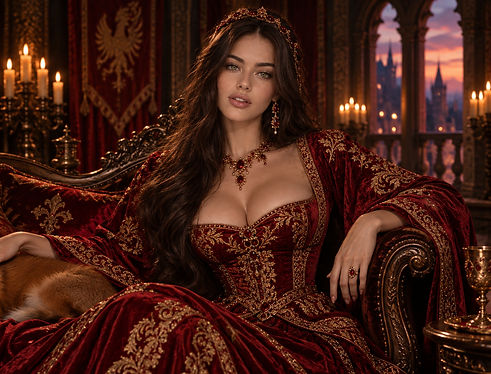
Born among the wealthy and politically sophisticated maritime cultures of medieval Italy, the fifth Maiden grows up surrounded by merchants, sailors, clergy, noble families, foreign envoys, contracts, rivalries, and the constant exchange of information and wealth. She learns early that power rarely belongs solely to those who carry swords; it belongs equally to those who know when to speak, when to remain silent, and what another person desperately wants. Her supernatural gift, Manipulation, develops through an extraordinary ability to perceive intentions, influence perceptions, and create illusions that make others question what they have seen or heard. Unlike the Whisper, who influences through subtle mental intrusion, she understands people through social intelligence and psychological instinct. Charming, witty, cultured, theatrical, and occasionally mischievous, she enjoys the game of politics almost as much as she enjoys winning it. Beneath her confidence, however, lies the loneliness of someone who has spent her entire life wondering whether anyone genuinely loves her or merely responds to the power she unknowingly possesses. Talysse's summons therefore offers her something no court ever could: the possibility of meeting people who might finally see the woman beneath the influence.
Ragnhild

Ragnhild
...
Born in the Scandinavian north on the same night as Talysse, the fourth Maiden enters a hard world of cold seas, forests, isolated settlements, Christian kingdoms, ancestral traditions, trade, and the enduring cultural memory of the old gods. Her upbringing teaches her that survival depends upon courage, loyalty, endurance, and one's word. From childhood she possesses an unnatural resistance to pain and fear, and as she matures she discovers that her strength, speed, and capacity for violence far exceed those of ordinary people. Yet she does not become a bloodthirsty warrior; instead, she develops a strict personal code and a profound hatred of cowardice and betrayal. Her aspect, War, represents not merely destruction but the force required to defend what one refuses to surrender. She becomes the shield of the Scarlet Maidens, the woman most willing to stand between her sisters and whatever threatens them. When the dream of the Red Castle finally comes, she follows not because she understands the prophecy, but because something within her recognizes the summons as a challenge—and she has never been one to turn away from a challenge.
Sundari
Sundari
...
Born in the Indian subcontinent beneath the same hidden celestial conjunction, the third Maiden grows up within a world of temples, sacred traditions, philosophical inquiry, pilgrimage, commerce, music, and deeply rooted family and community obligations. Her childhood teaches her that devotion can take many forms: devotion to family, teacher, deity, community, duty, and love. Yet her own presence gradually reveals something far more dangerous. People become intensely attached to her, seeking her approval, protection, or affection with a fervor she cannot explain. What begins as admiration eventually becomes obsession, forcing her to retreat from those she loves most. Her supernatural gift, Devotion, allows her to influence emotional bonds and inspire loyalty so profound that it can become indistinguishable from worship. Yet she is not herself cold or manipulative; she is perhaps the most compassionate of the seven, genuinely fascinated by the complexity of the human spirit and deeply troubled by the harm her presence can cause. When the summons of Talysse eventually reaches her, she recognizes it not as an invitation but as an answer to a question she has carried since childhood: whether there is somewhere in the world where what she is can finally be understood..

Anica & Dragana

The Twins
Anica & Dragana
The twins are two halves of the same supernatural nature, alike in face, blood, instinct, and unwavering devotion yet opposite in temperament, as though the Dragon divided a single spirit between them: one is the left hand, the other the right, each instinctively knowing where the other will move before she moves. The first is the quieter of the two, drawn toward shadow, silence, observation, and concealment, while the second is more passionate, expressive, and instinctively drawn toward warmth, movement, and flame; one withdraws where the other advances, one restrains where the other unleashes, yet neither is complete without the other. They have chosen never to speak aloud, not because they cannot, but because speech has always seemed unnecessary between them; from infancy they have communicated through a private mental bond, sharing thoughts, sensations, memories, warnings, and emotions with an intimacy no outsider can penetrate. In battle they move as though guided by a single consciousness, one anticipating the other's intention with impossible precision, and even separated by great distances they remain aware of one another's presence. Their differences do not divide them but complete them: shadow and flame, silence and passion, concealment and destruction, left hand and right hand—two bodies carrying what feels like one soul.


