V THE FIRST
THE SAGA

V The First
by WM
The world remembers the legend.
This remembers the blood before...
Dracula.


This is not a love story.
Although...

This is not a love story.
Although it is a story of love,
love in all its forms.
Beyond the drama of life,
the tragedy of the times,
and the horrors of the forces at play,
it is love that made it all,
not just bearable,
but possible.
It is love that binds it all together
It goes without saying that,
there are encounters that seem fated,
loves that seems destined.
Unions that bear the power to change the history of the world we share.

1.1

Janna
1400 AD
The Girl at the Edge
Around the dawn of the fifteenth century, in the Kingdom of Bohemia, a young girl found herself standing at the very edge of despair.
Janna had scarcely seen seventeen summers.
She was in the first bloom of womanhood, her beauty deepening with each passing day.
So too was her sorrow.
Born into privilege, she had known the warmth of noble halls and the promise of a great future.
Then tragedy came.
Her house fell.
Its name was forgotten.
Its honor reduced to whispers.
The descent was absolute.
Condemned to a life of servitude, she carried not only the shame of a fallen bloodline, but a far crueler burden.
She heard voices that no one else could hear.
They haunted her waking hours and poisoned her dreams until the world itself became unbearable.
At the edge of an abyss, she believed a single step would bring silence at last.
But there are moments that neither chance nor the will of men can alter.
Some encounters are written long before they come to pass.
Janna had been chosen by destiny.
She was fated to love a prince whose blood carried the legacy of kings.
From that union would be born a son destined to command armies, unite a fractured realm, and ascend as Vlad II, Prince of Wallachia.
And from his blood would come another.
A prince whose name would outlive kingdoms, inspire countless legends, and echo through the centuries.
Vlad III.
Dracula.
1300 - 1400 AD
The times were dark
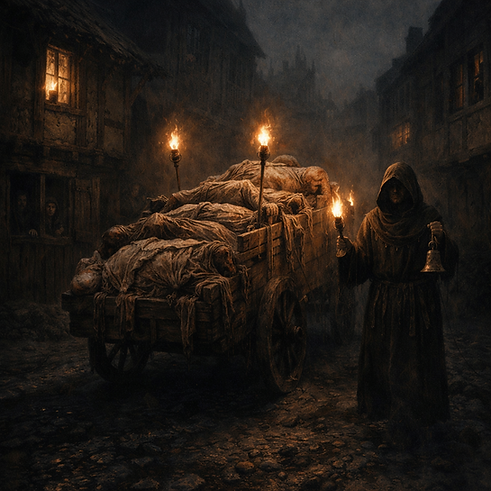
The dark ages
were darker than we dare remembering
And the middle ages,
hardly brighter.
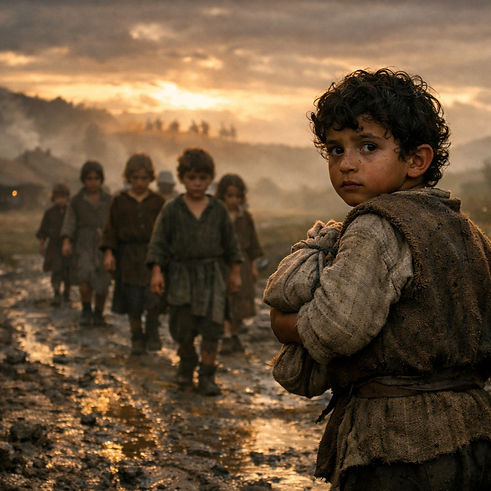
Whether the prophecies come from mortal prophets, or ancient oracles.
Neither mortal nor creatures can escape the hand of destiny.

Revelation 17
The Bible
The Vision (Verses 1–6):
One of the angels with the seven bowls invites the Apostle John to witness the judgment of the "great prostitute" who sits on many waters. John is carried into the wilderness where he sees a woman clothed in purple and scarlet, adorned with gold and jewels. She rides a scarlet beast with seven heads and ten horns. She holds a golden cup full of abominations and is drunk on the blood of Christian martyrs.
Revelation 71
Sacred Canon
The Four Great Oracles of the Elemental Temples spoke with one voice after beholding a vision granted beyond the veil of time:
From the catacombs of oblivion shall arise the Great Wolf, whose mane shall gleam like silver beneath the moon, and whose eyes shall burn with the fire of molten gold. Unto him shall be given dominion over the deathless, and by his coming shall the immortal know fear.
At the whisper of his name, rivers shall become crimson, and seas shall bear the blood of his kin, the world shall mourn without consolation, and the ancient Balance shall crumble in the twilight of the Age.

And while history tends to be rewritten to fit the narrative of the time,
Those things that came to pass were not chance.
There were destiny.
There are powers greater than men and monsters,
Powers that bow to none,
Neigther to light nor darkness.
And destiny binds us all.
And even the immortal Overlord,
cannot change their desnity.
The fastest way to meet ones fate,
Is by trying to prevent it

Wolfgang
1300 AD
Silver Wolf
In a forgotten age, long buried beneath the sands of time, while mortals lived their fleeting lives—waging wars, building kingdoms, knowing the ecstasy of love and the sorrow of loss—another world endured beyond their sight.
An unseen realm.
A hidden dominion that existed alongside the world of men, governed not by kings or emperors, but by the Sacred Canons—ancient laws forged through uneasy accord among the Alphas, Elders, Masters, and Supreme Lords of the great races and tribes that dwelled beneath the veil.
For centuries, the Balance endured.
Fragile.
Imperfect.
Yet unbroken.
Until the prophecy came.
The Great Oracles of the Four Elemental Watchtowers—the oldest temples in existence, whose guardians watched over both the realm of men and the Unseen Realm—were the first to behold it.
Their visions were not of hope.
They were drenched in blood.
They saw betrayal.
A war unlike any before it.
The annihilation of an ancient and mighty race.
And from the darkness of forgotten catacombs would rise a Great Silver Wolf, the harbinger of immortal death.
The ancient prophecy had awakened.
The Lords Revenant—the immortal sovereigns of the Eternal Court, eldest among the Children of the Night and conquerors of death itself—were the first to understand what the prophecy foretold.
It spoke not of conquest.
But of their end.
And so they struck before destiny could.
They came for her.
Throughout history she had borne many names.
Lupa.
The Snow She-Wolf.
The All-Seer.
The Witch of the Woods.
Yet she answered only to Dacinne, the Spirit of Dacia.
She was neither Lycan nor Revenant.
She was something else.
Ageless.
Quiet.
Unassuming.
Her eyes, radiant as molten gold, beheld what no other living soul could perceive—the forgotten past, the uncertain future, and the hidden truths concealed within the present.
The wolves revered her because she alone could manifest her daemon: a colossal white wolf born of spirit rather than flesh.
When the two became one, she transformed into something neither woman nor beast, but a sacred union of both—a living embodiment of powers the Lycans themselves scarcely understood.
She had walked beside history without ever belonging to it.
She appeared in the age of Romulus and Remus, vanished into legend, and returned whenever destiny required her presence.
Where wolves prowled the forests and bats ruled the night, the Lycan Clans worshipped her as their holy prophet, their guardian, their promised salvation.
She claimed none of those titles.
Yet she became something greater.
When the Revenants seized her, the Lycans marched to reclaim her.
Thus began the greatest war the Unseen Realm had ever known.
When it ended, only one great race remained unbroken.
From that day forward, the Revenant Lords ruled the Unseen Realm with an iron hand, enforcing the Sacred Canons through fear, dominion, and absolute authority.
For centuries, none dared challenge them.
They believed they had conquered destiny itself.
But destiny is patient.
It cannot be imprisoned.
It cannot be slain.
And in the Year of Our Lord 1300, the ancient prophecy stirred once more with the birth of an extraordinary child.
A boy with silver hair.
Eyes of living gold.
The Silver Wolf had returned.
In the begining
When the world was new...
“When the world was new, dark and empty,
she was there.
When the first dawn came about,
and the first man gave his first steps,
she was there.
She walked the land under pallid moons
and blazing fires,
with no one to share her endless night.
Then there was light.
She was the first of all of us,
Us, Children of the Night,
The All-Mother in the Dark,
was the First, yet not the last.
She was there from the beginning,
She will be there beyond the end.
V The First
Preamble:

"I’ve been watching humanity for eons.
I remain profoundly...
Unimpressed."
"I’ve been watching humanity for eons.
I remain profoundly...
Unimpressed.
You believe we all live in the same world. Yet the world of the rich is not the world of the poor. The beautiful walk a different realm than the wretched. Even the world you knew in your tender years is not the one that greets you in later life.
What you call the world is merely what you see—a fragment of countless overlapping realities.
There is, however, another. It lies within, beneath, and all around your world, often hidden in plain sight behind a veil of shadows and deceit—an underworld, if you will.
You already know it. A world just beyond the grasp of the senses. You whisper of it at firesides. You glimpse it as that fleeting shadow caught in the corner of your eye. You feel it in the sudden silence of the forest, in the cold breath along your neck, in shivers that creeps along your spine, in the dark corners of dreams you dare not name aloud.
Like your own, this unseen realm is inhabited by a myriad of different tribes and hierarchies. Some can change their shapes; others wield natural forces or the minds of men. Some have even returned from the grip of death to never again fall in its thrall.
And, as with you, their lineage can be traced back to a single origin, a common source — a primal matriarch:
The All-Mother in the Dark.
She is the first of all. A deity older than memory, older than the world itself. Bound in flesh, immortal not by choice. She cannot die—yet death may be the one thing she longs for, more than you long for life. So, she dreams, hidden in the bones of the earth. And her dreams bleeding into yours.
She is mother and foremother to all Children of the Night.
And as for me…
I am something else entirely."
THE SAGA
THE BOOKS

The Book
Travel in time to distant land.
Meet those who wrote the names in history.
Read the words that can take you there
The novels form the foundation of V the First, unfolding the central story across generations of dynasties, prophecies, hidden powers, and those whose births may have been foretold long before they understood their place in the world. Through the written word, the saga has room to explore its history, characters, mysteries, and consequences in their fullest depth.
Explore the Books →
THE SAGA
GRAPHIC NOVEL

The Comics
Not only read about them,
See them with your own eyes
The graphic novels bring the realms of V the First into visual form, transforming pivotal moments, characters, and places into illustrated sequences where atmosphere and expression become part of the storytelling. Each volume offers another way into the saga, revealing its world through imagery while expanding the experience of its stories.
Explore the Graphic Novels →
THE SAGA
AUDIO BOOK

Audiobook
Close your eyes and
Hear the story awaken.
The audiobooks transform the written saga into an experience of voice, atmosphere, and sound. Narration carries the listener through the kingdoms, forests, courts, and unseen realms of V the First, allowing its history and mysteries to unfold in an entirely different way—one meant to be heard as much as imagined.
THE SAGA
VIDEO GAME

Video Game
Become legend
Enter the world. Choose your path. The video games extend V the First beyond the boundaries of the written narrative, allowing audiences to enter its realms and experience its history through interaction. Through exploration, discovery, and choice, the world becomes more than a story to witness—it becomes a place to encounter. Explore the Video Games →


V The First
About the Prologue

The Prologue
An entire story on its own about how a warlord build a throne and sire a dynasty that will survive him across the centuries
The world remembers a prince who became a legend.
History remembers a single name.
Dracula.
Yet few remember that behind the myth stood a man of flesh and blood.
Vlad III, son of Dracul, Prince of Wallachia.
Long before the legend, there was a dynasty.
Before the son, there were fathers and forefathers.
Before the fathers, there was a founder.
Basarab.
He inherited nothing.
He forged a crown where none existed, carving a kingdom from steel, blood, and unyielding will.
In the fourteenth century, Basarab gave birth to a dynasty whose shadow would endure long after kingdoms had fallen into dust.
Yet history preserves only fragments.
Its chronicles recount battles, treaties, and kings, while leaving untouched the deeper current flowing beneath them all.
For hidden beneath the rise of kingdoms and the collapse of empires endured an older inheritance—a secret bloodline born from a power more ancient than crowns, more enduring than nations, and older than faith itself.


