V THE FIRST
WARLOCKS

About
WARLOCKS
The evidence shows that Warlocks are NOT, in fact, the males of the ‘Sorciè’ species. Warlocks and Witches are completely different species, even though they branched out from a common ancestor countless generations ago…”
— Lord D.
Warlocks
When the forces of nature are channeled through the male form
Warlocks are not male witches.
Though the two share an ancient and disputed ancestry, the centuries have carried them upon different paths, until what was once kinship became little more than a memory preserved in blood.
Where witches draw themselves toward the earth, the warlock turns his nature toward the heavens. Fire answers him. Air obeys his will. The Sun governs his rhythm, as the Moon governs that of the witch. Yet neither element nor celestial body grants him his power. They merely reveal what already lies within his blood.
The warlock is born with his inheritance. It is not learned, though it may be refined; nor is it bestowed, though it may be awakened. The Mark of Cain rests upon them all, though it speaks more strongly in some than in others.
Their nature is solitary. They make territories rather than homes, rivals rather than neighbours, and bloodlines are more often remembered by the name of a man than by the house from which he came.
Among them, strength is both inheritance and hunger. What one warlock possesses, another may covet; what one conceals, another may kill to obtain. Their oldest traditions therefore speak not only of power, but of its price—for among the warlocks, the greatest danger has seldom come from outside their kind.
Some chronicles maintain that witches and warlocks were once two branches of a single people. I have found little reason to dispute their ancestry, but still less reason to call them kin.
Time has a way of making strangers of those who were once brothers.
Lord— D.
So writes Lord Darius von Croÿ, who has watched the blood of Cain pass from father to son, and has learned that among the warlocks, power is rarely inherited without hunger—and hunger is rarely satisfied without blood.
WARLOCKS
On the nature of...
On the Nature

The Cainians

The Abelian

The Cronus'

The Dyad

The Dyand II
The Abelian Triad

The Brotherhoods

The Canian Triads
I
The Warlock Physis
On the nature of Warlocks
Warlocks belong to the Children of the Unseen, though their nature is considerably removed from that of witches. They remain mortal in flesh and subject to death, yet the power carried within their blood places them beyond the ordinary human order. Where witches draw their strength upward through the living earth, the warlock draws his downward from the heavens. Where the Moon governs the rhythms of the witch, the Sun governs the warlock. His traditional elements are Fire and Air, forces associated with expansion, heat, motion, will, and destruction. This division is not absolute, but it is sufficiently consistent to have survived among warlock traditions for many centuries.
II
The Warlock Genos
The Warlock is a distinct Genos, not the male expression of the Witch.
The two may share a primordial ancestry, but whatever bond once joined them has been severed by the long alchemy of time. Their similarities are therefore vestiges rather than evidence of present kinship.
The warlock is an inheritor of power rather than a mere practitioner of it. His blood carries the potential for supernatural force from birth, and that inheritance becomes both his greatest gift and the source of the hunger that governs his existence.
III
The Warlock Ethnos
Two principal branches are recognized among the Warlocks:
Cainian — those who bear the blood of Cain in its dominant expression.
Abelian — the lesser and considerably rarer branch, retaining a stronger affinity with the blood attributed to Abel.
Approximately nine in ten known Warlocks are Cainian. The remainder are Abelian.
The distinction is not absolute, nor does it determine the worth of an individual. It does, however, influence temperament, reproductive capacity, and the manner in which power is acquired and preserved.
IV
The Warlock Oikos
Unlike witches, warlocks possess little attachment to hereditary households.
Their lives are more often solitary, territorial, and transient. A warlock may guard a place for decades, but his claim rarely becomes a dynasty. To gather too many of his kind in one place is to invite competition, and competition among warlocks is rarely settled through negotiation.
The strongest bloodlines therefore tend to be remembered through individuals rather than houses.
V
The Warlock Archē
The Warlocks possess no universal hierarchy comparable to the Revenant Archē. Their rank is determined less by inheritance than by power, age, knowledge, and the number of rivals they have survived.
Among Cainian traditions, the oldest and most dangerous may be referred to as Cronus—warlocks who deliberately sire offspring for the sole purpose of allowing their own power to multiply within the child before reclaiming it through ritual.
The Cronus are not merely practitioners of a cruel art. They represent the logical extreme of warlock nature: the reduction of creation itself into another method of acquisition.
VI
The Witches Traditio
The traditions of the Warlocks differ considerably from those of witches.
Where witches preserve knowledge communally, warlocks tend to guard it individually. Grimoires are concealed. Techniques are withheld. Familiars are closely bound. The secrets of one practitioner are often the very things another would kill to possess.
The principal traditions are associated with the mastery of Fire, Air, Will, Blood, Ritual, and the darker arts of Consumption, though no complete catalogue has ever been agreed upon.
Among the most dangerous practices is the absorption of another warlock's essence through the consumption of organs, blood, and other vital substances. Such acts are not regarded by all warlocks as equally acceptable, but among the Cainian branch they are sufficiently common to have become part of the oldest traditions.
WARLOCKS
THE CANIANS

Cainian
With the blood of Cain
The name comes from the biblical Cain. Ninety in a hundred are Cainian.
Solitary, territorial, steeped in violence, they are creatures of blood-urge and murder-lust. Their survival depends upon it. To endure, they must slay. The ancient ones are monstrous indeed, tempered by centuries of killing, made cunning through endless survival.
Reproduction is abhorrent to them, for the seed of man drains their essence. Yet when a child is conceived, the father’s power multiplies within the womb of the mortal mother, in the secret process called The Alchemy Within. Sons born of this act are always warlocks. Daughters, when they appear at all, emerge broken and perish at birth in most cases.
Among the Cain dwell the Cronus—monsters who sire children for no purpose but to devour them, reclaiming tenfold the strength lent to the womb. These are not ruled by the Sun, but by Saturn, dark lord of devouring time.
WARLOKS
THE ABELIAN
Abelians
The Gentle Persuasion
The Abelian are the lesser branch of that tree, a scant ten in a hundred. They are wanderers, unable to claim ground without attracting the slaughter of rivals. Unlike the Cainian, they are softer in temperament, given to retreat rather than to battle. Yet solitude dogs them, for their very nature compels them to seek union with their own kind.
Like the Cainian, they lose power through the act of climatic release. Yet unlike them, they may gain strength if they drink from the seed of another. Thus many Abelians resort to a strange preservation: swallowing their own issue, lest desire strip them of power and expose them to death.
They cannot sire bloodlines, yet every Abelian has been sired by a Canian, for Cain and Able share blood and it mingles lineage.
“Thus are the warlocks: the sons of the Sun, yet parasites upon themselves. Not brothers of witches, nor lovers of men, but a species apart—cursed to feed upon their own flesh until none remain.”

WARLOKS
THE CRONUS

Cronus
The Devourer
The Cronus is a nature of the Cainian Warlock—the hunter turned upon his own blood. Named after the Titan Cronus, the Cronus sires sons for one purpose: to one day devour them. The mother is deceived, never told that the child is destined for sacrifice. Always male, the child inherits a portion of his father’s power, and as he approaches puberty, the ancient alchemy of the womb awakens, multiplying that inheritance within him. When the time comes, the Cronus reclaims it through blood and flesh, consuming the son’s body—eyes, organs, flesh, and whatever else carries his power.
The Cronus is therefore known in the Codex as the Devourer of His Brood. His greatest weapon is not merely his magic, but his bloodline itself: every son he sires becomes both vessel and victim, growing stronger until he is ripe for consumption. Among the Warlocks, this is regarded as one of the most profane expressions of Cainian nature. Where the Abelian is prey to his kin, the Cainian is their hunter—and the Cronus represents that hunger carried to its most terrible conclusion: a father who breeds his own blood only to harvest it.
CHILDREN OF THE NIGHT
WARLOCKS

Duncan

Armand

Jean Pierre

Aiden

Marcel

Mathis

SIlas

Paul
WARLOKS
The Dyads


The Warlock Dyad
Together their power multiplies.
At a price
The Dyad is the rarest and most sacred bond known among warlocks. Born when twin brothers inherit the blood of Cain, they share a connection so profound that each becomes the other's greatest source of strength, their magic intertwined as though they were two halves of a single soul. Yet within this extraordinary union lies the seed of inevitable tragedy, for the same ancient blood that binds them in perfect harmony will, in time, compel one to destroy the other. Thus, the Dyad stands as both the highest expression of brotherhood and the cruelest curse ever woven into the lineage of warlocks.
BESTIARY
THE ABOUTS

The Abouts
by Lord D.
I've witnessed it often enough to recognize the pattern.
No warlock, any more than any other creature fashioned beneath Heaven, can wage war against his own nature and hope to prevail.
Each bears the Mark of Cain, and each, without exception, must one day stand before the oldest truth of their blood. They will kill one of their own, or they will perish by the hand of a fellow warlock. Jealousy, ambition, hunger, envy, or those darker compulsions that none among them will ever confess aloud—every path leads toward the same inevitable reckoning.
The birth of a warlock is among the rarest of cosmic occurrences, for few willingly pay the terrible price that creation demands. Most choose solitude over legacy, knowing that every child born into their bloodline awakens forces older than kingdoms and more merciless than fate itself.
A warlock inherits his first measure of power not through murder, but through his father. Yet that inheritance is enough to condemn him. From the moment his gift awakens, his life becomes a relentless pilgrimage through shadow. He will spend his years as prey fleeing older warlocks, or as a hunter pursuing younger ones. Often, he becomes both.
And yet, once in many centuries, even those who have wandered too long through blood and exile may stumble upon something they believed forever beyond their reach.
Love.
The kind for which a man would gladly kill.
Or surrender his own life without regret.
On rarer occasions still, destiny grants an even stranger miracle.
A single seed gives rise not to one child, but to two.
Warlock brothers.
In their youth they share a bond that language scarcely possesses the grace to describe. It is as though a single soul had been divided before birth, each brother carrying the echo of the other through dreams, silences, and unspoken understanding. Should they survive the perils of their early years, they often choose to bind themselves in an ancient union known among their kind as a Dyad—a communion of spirit, mind, and power unlike any other known within the Unseen World. No friendship, no oath, no earthly affection rivals its depth. United, they become stronger than either could ever hope to be alone.
But no blessing carried within the blood of Cain is granted without its curse.
Born of Cain's accursed lineage and the infernal blood of the succubus who bore his descendants, every warlock carries within him an ancient hunger that cannot forever be denied. Sooner or later, the call of their nature awakens. The brother who once completed them becomes the one destiny demands they consume—or the hand by which they themselves shall fall.
Thus the Dyad becomes both the purest expression of devotion and the cruelest design ever written into mortal blood.
For a fleeting span of years, they walk the world as two halves of a single destiny, inseparable, joyous, and formidable beyond measure.
Then destiny remembers its ancient covenant.
And the blood remembers first.
Duncan
Duncan
The Abelian Alpha
Lord Duncan Baudelaire is the warlock-founder and Grand Master of the first — and only — coven of warlocks on the continent: La Confrérie des Cœurs Saignants (The Brotherhood of the Bleeding Hearts).
Though much of his life was devoted to forbidden indulgences — the embrace of men, and the pursuit of occult lessons proscribed by both Church and Canon — he transgressed further still. Against the decrees of the Sacred Canons, which forbade interbreeding among the Children of the Night, Duncan fathered a child with a minor deity, sealing a legacy both perilous and profane.

Aidan

Aidan
The Lost Brother
Lord Duncan Baudelaire is the warlock-founder and Grand Master of the first — and only — coven of warlocks on the continent: La Confrérie des Cœurs Saignants (The Brotherhood of the Bleeding Hearts).
Though much of his life was devoted to forbidden indulgences — the embrace of men, and the pursuit of occult lessons proscribed by both Church and Canon — he transgressed further still. Against the decrees of the Sacred Canons, which forbade interbreeding among the Children of the Night, Duncan fathered a child with a minor deity, sealing a legacy both perilous and profane.
A warlock bonding and binding a second time, unheard of.
Losing his brother, the other half of his dyad, left Duncan so profoundly wounded and broken that there was no rest in his sleep, no peace, no pleasure, no joy in his days.
Only in solitude of a lost woodland he could quiet the voices of regret and sorrow. There is where he wished to spend the rest of his days.
He was done with warlocks, with love, with the entire world.
They were not done with him.
Silas came full of past and urgency,
No words. The face of a second chance.
It changed it all.
WARLOKS
THE SECOND DYAD

Two Again
The Second Chance to change it all
Duncan was thee in those wood because he was escaping his past.
Silas was running for his life.
Three warlocks found themselves in the same place at the same time.
The hunter wanted power at all cost.
The boy wanted to live.
Dunca, heir to the inmense power of the House of Baudelaire, only wanted peace.
Even if it meant killing.
Silas lived, because of Duncan.
Silas wanted to keep being alive. So Duncan found himself suddenly sharing his solitude, with the mute boy who came to love him like no one else.
Silas
Silas
The Silent Power of Fait
Most of childhood, he lived hidden in the cellar of what to outsiders consider a respectable household.
His mother did her best, victim of her own tragedies she spent her entire pregnancy on the run. Escaping from the man who got her pregnant.
Not a man.
A warlock.
One can never run fast enough, or hide well enough when what hunts you is a warlock hungry for you powers.
At least he did not kill him,
He only mutilated him. He stole his voice.

WARLOKS
THE TRIAD

The Warlock Triad
It is three that breaks the curse of their kin
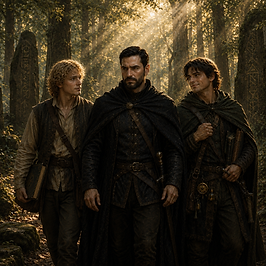
Armand was not the first to learn of the two warlocks hidden within the woods. Little remains concealed from a warlock where the hierarchies and territories of the underworld are concerned.
But Armand was the first to draw near.
And he came to stay.
"It is difficult with two; with three, impossible," they said.
They were mistaken.
There was friction, jealousy, and moments that bore the unmistakable shape of betrayal. Yet Armand came to occupy a place with such quiet inevitability that it seemed to have awaited him from the beginning.
A triad of warlocks, bound not by blood.
It was, in many ways, a cosmic event.
Armand
Armand
The Third One
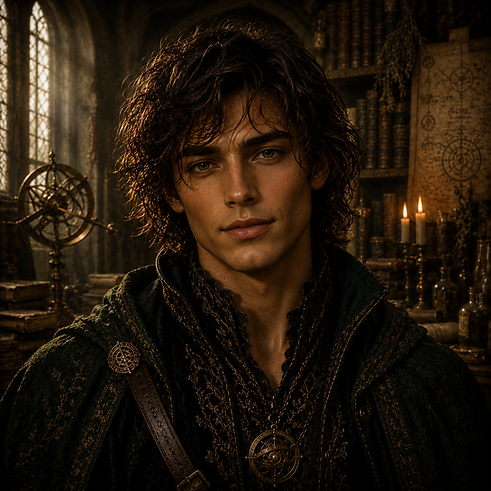
Armand appeared in the woods Duncan had long claimed as his own. He knew the great warlock had accepted a boy named Silas—a lesser kin so broken that few would have called him a warlock at all. Armand believed it was Silas who had opened the path to Duncan's heart. He knew many things, though he revealed very little. A wide smile rarely left his face, and the wicked glimmer in his eyes always made others feel as though they had become the subject of a private joke. No one could ever know what he was thinking, but he often knew what they were feeling.
Armand was an empath, sensing emotions so deeply that he could glimpse the memories from which they were born. He knew what people desired, and what they truly needed. More often than not, he offered both.
Whether from kindness, mischief, or some hidden purpose, no one could say. His true intentions were revealed only with time, and even then they remained uncertain. A trickster, they called him—a free spirit untouched by fear, regret, or worry for tomorrow. You might never trust him completely, but you would always want him on your side.
More came

WARLOCK
THE BROTHERHOOD

BROTHERHOOD
The Brotherhood of the Bleading Heart
Never before had a Warlock achieved
what Duncan brought into being.
Duncan, the Triad, and the ancient woods became a beacon in the darkness—a refuge whose call was never spoken, yet somehow heard. From distant places, they came: wanderers, fugitives, outcasts, and those who had nowhere else to turn. One by one they found their way through the forest, drawn to something they could neither name nor understand.
And as their numbers grew, so too did the thing they created together. What began with three became a brotherhood; what was once a hidden refuge became a sanctuary, a school, and a force unlike anything the world of warlocks had known before.
It became the first—and only—coven of Warlocks ever recorded in history.
They called it the Brotherhood of the Bleeding Heart.
What began as an unintended call became a gathering of souls the world had forgotten—and together, they became impossible to ignore.
WARLOKS
THE ARTOIS

The Artois Triad
The infamose Artois Brothers
The Artois Brothers occupy a dark and infamous place in the chronicles of V the First. Known throughout the Unseen Realm as the Cainian Triad of Warlocks, Marcel, Paul, and Jean Pierre Artois were brothers bound not only by blood, but by an ancient inheritance of forbidden magic. Their name became synonymous with ambition, cruelty, and occult power, and the House of Artois grew wealthy and influential beneath Marcel’s command. Yet each brother carried his own particular manifestation of the dark arts: Marcel, the calculating patriarch with his black serpent familiar; Paul, the elegant and deceptively charming brother whose golden orb-weaver spider reflected his affinity for patience and entrapment; and Jean Pierre, the most openly sadistic of the three, whose scorpion familiar seemed almost an extension of his venomous nature.
Within the books of V the First, the Artois Brothers represent one of the oldest and most dangerous strains of Warlock blood in the Unseen Realm. Their legacy reaches beyond their individual deeds, becoming part of the hidden history of the covens, the forbidden sciences, and the ancient struggle between those who wield magic and those who seek to control it. They are not merely villains of their age, but remnants of a darker tradition—men who inherited knowledge that should perhaps have remained buried. In the chronicles, the name Artois is therefore spoken with the same caution reserved for other forbidden names: a reminder that among the Children of the Unseen, the most dangerous monsters are sometimes those who remain entirely human.
Marcel Artois
Paul Artois
Jean Pierre Artois
Marcel Artois

Marcel
The Head of the Snake
Marcel Artois the eldest and most powerful of the infamous Artois brothers. Born in the brutality of extreme poverty was the protector who shielded his younger brothers, twins Paul and Julien, from the perils of both poverty and predatory warlocks. It was Marcel who proposed their eternal blood pact, and it was he who led them to wealth, pleasure and power. Cunning, ambitious, and merciless, was executed for breaching the Sacred Canons.
Paul Artois
Paul
Madame Baudelaire
Paul Artois was the youngest of the infamous Artois brothers, and stood apart in temperament and appearance. Unlike his brothers, he harbored little thirst for domination. In secret, he fell in love with Jacqueline, a servant girl and produced a child—Mathis—who was kept a secret until he and his brothers were executed for breaching the Sacred Canons.

Jean Pierre Artois

Jean Pierre
The Scorpion
Jean Pierre was the second-born of the Artois brothers and twin to Julien, though he resembled Marcel in both appearance and cruelty. Silent, brooding, and unpredictable, Paul was the enforcer of the trio—the one who dealt with threats through violence, intimidation, and unspoken brutality.
Mathis Artois
Mathis
The Moth
Born in 1332 to Jacqueline, a servant within the magnificent and secretive Artois mansion, Mathis spent his childhood hidden beneath the splendor of the estate that would one day belong to him. Raised among the servants’ quarters and kitchen halls, he was permitted above only when the masters were absent. The Artois brothers had appeared in the Parisian courts of the early fourteenth century as nobles of mysterious origin, possessing impossible wealth, influence, and knowledge. Whispers followed them—of forbidden societies, dark rituals, and blood sacrifices. The rumors were dismissed by the world of men, but within the shadows of the Artois estate, they were all true.
Kept hidden for his protection, Mathis grew up as the forgotten child of a house that allowed no heirs to be seen. By the time he reached adulthood, the infamous Artois brothers were gone, their enemies silenced, and their secrets buried. Only then was the truth revealed: Mathis was the last heir of the Artois bloodline. He inherited not only their vast fortune, noble titles, and forbidden archives, but also the supernatural power carried through his blood. Yet one mystery remains at the heart of his legacy: who was his true father, and why did the most feared warlocks in history ensure that he would survive?


