EMBER CODEX
THE ANOINTED ONES

The Anointed
“Spill not the blood that bears the seal,
for in its ruin the woven fate of realms would fray.”
Across the turning of centuries, there have arisen certain mortals set apart from their own kind—men and women whose lives bore the weight of unseen favor. Some were watched over by the hand of the Divine, others safeguarded by the solemn decree of the Overlords of the Underworld.
Their blood was never to be spilled in sacrifice or rage; their will was not to be bent by sorcery or shadow; no harm was to touch them by forces beyond the natural world. Such was the covenant sealed over their lineage, as though the threads of their existence were too tightly woven into the pattern of things to be severed.
Among these guarded lines stands the House of Basarab, its name carried forward beneath this ancient protection—a bloodline spared by both Heaven and the dark realm alike, destined to carve its mark upon the pages of history.
It is whispered that the earth itself recoils from the spilling of their blood, for in that crimson tide sleeps the echo of older promises yet unbroken.
WHO:
HOUSE OF BASARAB

The Basarabs
The Warlord Princes of the Balkans
Across the turning of centuries, there have arisen certain mortals set apart from their own kind—men and women whose lives bore the weight of unseen favor. Some were watched over by the hand of the Divine, others safeguarded by the solemn decree of the Overlords of the Underworld.
Their blood was never to be spilled in sacrifice or rage; their will was not to be bent by sorcery or shadow; no harm was to touch them by forces beyond the natural world. Such was the covenant sealed over their lineage, as though the threads of their existence were too tightly woven into the pattern of things to be severed.
Among these guarded lines stands the House of Basarab, its name carried forward beneath this ancient protection—a bloodline spared by both Heaven and the dark realm alike, destined to carve its mark upon the pages of history.
It is whispered that the earth itself recoils from the spilling of their blood, for in that crimson tide sleeps the echo of older promises yet unbroken.

Basarab

Janna

Vlad II

Mircea

Radu

Vasilissa

Mara

Calinichia

Wolfgang
Basarab I

Basarab
The Founder
Some men inherit kingdoms; Basarab I forged one from defiance. I remember him before the chroniclers crowned him the founder of Wallachia, when he was little more than a warlord whose resolve proved stronger than the armies sent to break him. Against kings, steel, and impossible odds, he secured the freedom of his people and planted the first roots of a dynasty whose branches would spread across centuries, giving rise to noble houses and shaping the fate of Eastern Europe. Yet those who praise only the sovereign have mistaken the man for the legend.
There are older records, sealed beneath leather and stone, that speak of another inheritance. They whisper of Dacianne, the All-Seer, and of a bond forged not merely in love, but in prophecy—a union from which a hidden bloodline may have emerged beyond the sight of history. Whether those pages preserve truth or heresy, I have never revealed. I know only this: the greatest legacy Basarab left behind was not the kingdom he founded, but the blood that endured after him. And somewhere between crown and shadow, that blood began its long journey toward a name the world would one day fear above all others: Dracula.
Mircea I
Mircea I
1355 – 1418
There are rulers whose names survive because they conquered kingdoms, and there are those whose memory endures because they altered the course of time itself. Mircea of Wallachia belonged to the latter. I have seen countless princes crowned beneath vaulted cathedrals where candlelight trembled upon ancient stone, yet few bore the quiet certainty that rested upon his shoulders. He inherited a fractured realm poised between rival empires and transformed it into a kingdom of uncommon strength. Laws replaced disorder, prosperity flowed where famine had lingered, forgotten fortresses rose once more above the forests, and the banners of Wallachia reached horizons no Basarab had ever claimed. Yet those who measured his greatness only by victories never understood the deeper burden he carried. A crown forged in an age of wolves is never fashioned from gold alone.
There were nights when Mircea lingered above the mist-veiled waters of the Danube long after his court had fallen silent, listening to whispers no chronicler dared preserve. Whether they belonged to God, to memory, or to something older still, I cannot say. It was during his reign that destinies, long scattered like embers across the centuries, began gathering into a single flame. Kingdoms believed they were witnessing the triumph of a remarkable sovereign; they did not see that history itself had begun arranging the birth of a bloodline whose final heir would eclipse every ancestor before him. And if Mircea ever understood what his descendants were destined to become... he carried that knowledge into the grave, leaving only silence to guard the truth.

Radu I

Radu I
Voivode of Wallachia,
Father of Mircea I
Radu I was a prince of the House of Basarab, son of Nicolae Alexandru, and half-brother and successor of Vladislav I. He shared power with Vladislav before succeeding him as Voivode of Wallachia around 1377, ruling until approximately 1383. His reign continued the consolidation of Basarab authority in Wallachia, while his coinage and surviving foreign references attest to an established and functioning princely government. Radu was also remembered for his support of the Orthodox Church, and his name became closely associated in later tradition with the legendary Radu Negru, the supposed early founder of Wallachia. He was the father of Dan I and Mircea I, the latter of whom would become one of medieval Wallachia's most important rulers. Though Radu's own reign was brief, he stands within the direct Basarab succession that carried the principality from Basarab I, through Nicolae Alexandru and Vladislav I, to Mircea I—making him an important link in the lineage from which Wallachia's greatest medieval prince emerged.
Calinichia
Calinichia
Dowager Princess
Doamna Calinichia Basarab, mother of Mircea I and consort of Radu I of Wallachia, was a woman of extraordinary beauty, intelligence, and quiet authority whose origins remained deliberately obscured, with whispers of Byzantine, Serbian, and ancient Wallachian blood surrounding her lineage. Born around 1340, she entered the House of Basarab through marriage and became the mother of one of Wallachia's greatest voivodes, raising Mircea with a keen understanding of diplomacy, dynastic politics, warfare, and the burdens of rule. After Radu's death, she became the formidable dowager princess, remaining an influential presence at Mircea's court and one of the few people before whom the mighty voivode was still simply her son. By 1400, age had transformed her youthful beauty into something sterner and more commanding—silver-haired, regal, and richly dressed in dark velvet, fur, pearls, and old gold—yet behind her weathered features remained the same piercing blue-gray eyes and an unsettling sense that she knew far more about her family's bloodline than she ever revealed.

Mara
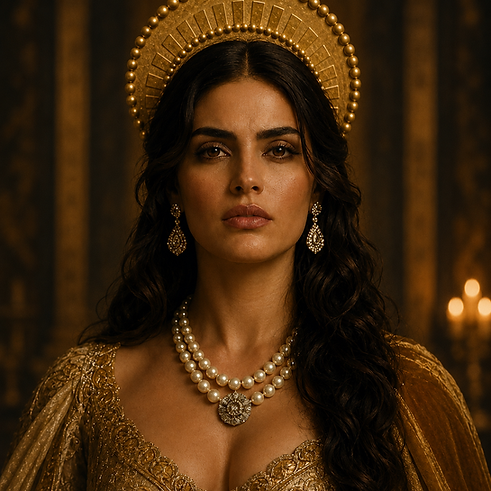
Mara
Princess of Wallachia
Some names survive in royal genealogies; others are carried only by water. Maria Tolmay, remembered in whispers as Mara of Balaton, belonged to a forgotten Hungarian house whose banners vanished long before their blood was spent. She was born upon the mist-veiled shores of Lake Balaton, where reeds bowed with the wind and the silence of the water seemed older than kingdoms themselves. When fate carried her across the Carpathians to the court of Mircea of Wallachia, the prince saw beyond her quiet beauty. He recognized the rare strength of a woman whose presence steadied a throne more surely than steel or armies ever could.
Within the candlelit halls of Târgoviște, Mara became the still heart of a restless kingdom, and from her was born Michael, the heir destined to carry the Dragon's blood into another age. Yet history, ever faithful to kings and indifferent to queens, allowed her own story to fade into its margins. Only the oldest chronicles hint that she guarded a secret entrusted to no court and recorded by no priest—a truth she carried from the waters of Balaton to her grave. Whether that secret died with her, or passed unseen into the blood of her descendants, I cannot say. But there are nights when the lake still speaks her name... and something beneath its dark waters answers.
Janna
Janna
The Womb of Fate
Born beneath the fading banners of an ancient Bohemian house, Janna Nováková entered the world surrounded by every promise of nobility, only to lose it before childhood had surrendered to youth. Orphaned, forgotten, and delivered into the care of distant kin whose halls concealed more shadows than kindness, she endured years of quiet suffering that neither diminished her grace nor extinguished the uncommon light she carried within. While cruelty sought to reduce her to silence, destiny had already begun tracing another path—one that would draw the gaze of a prince and alter the course of kingdoms.
For a single season, as the waters of the Danube carried them beyond the reach of courts and conspiracies, Janna discovered a love powerful enough to challenge duty itself. Yet some souls are remembered not for the years they lived, but for the blood they left behind. From her final breath would emerge a lineage destined to shape history, inspire legends, and awaken fears that have never entirely faded. Whether Janna was merely a forgotten noblewoman... or the first thread in a design woven by far older hands, remains a question that the oldest chronicles still refuse to answer.

Vlad II

Vlad II
Dracul (The Dragon)
The old chronicles remember him as Vlad II Dracul—the Dragon—yet even that name conceals more than it reveals. Born of the House of Basarab, he came into an age when kingdoms were measured not by their borders but by the blood they were willing to surrender. His youth unfolded beneath vaulted halls where steel was blessed by candlelight and oaths were spoken in voices scarcely louder than prayer. Before princes entrusted him with crowns and emperors sought his allegiance, another inheritance had already found him: the terrible knowledge that a ruler standing between East and West belongs wholly to neither. From that hour onward, every river crossing, every castle gate, and every feast concealed the scent of betrayal beneath velvet and incense.
Those who knew him best spoke less of the battles he fought than of the silence he carried after them, as though he had glimpsed something waiting beyond victory itself. Some claimed the Dragon was merely the emblem of a knightly order. Others, in whispers reserved for forgotten chambers lined with cracked leather and ancient stone, insisted the title marked a covenant far older than any king dared acknowledge. His reign would shape the destiny of Wallachia, but the true consequence of his life was not the throne he defended. It was the child who watched from the shadows... and the unseen hand that had been guiding the blood of the Basarabs long before the Dragon first drew his sword.
Vasilissa
Vasilissa
The Mother of Dracula
Vasilissa Cneajna, Princess of Moldavia and Wallachia, was born of the ancient House of Mușat, where crowns were measured not by splendor but by the alliances they secured. Raised amid the shifting ambitions of the Balkan courts, she learned that mercy was a luxury few sovereigns could afford. When she was promised to Prince Vlad Drăculești, heir to the House of Basarab and knight of the Dragon, the union promised to bind two great dynasties beneath a single destiny. She possessed every virtue demanded by kingdoms—beauty, lineage, intelligence, and unshakable resolve—but beneath the brilliance of silk and gold lay a will as cold as polished steel. Yet the prince's heart had already been claimed by another, a woman whose existence belonged more to whispered legend than to history.
The chronicles record a royal wedding; the oldest manuscripts tell a darker tale. While priests blessed the marriage above, shadows gathered below the palace, where vows were broken, a forgotten bride vanished, and an infant's fate was quietly rewritten before the light of dawn. Whether Vasilissa acted from love, ambition, or a design conceived long before her birth, even I have never discerned. I know only that the child she presented to the world as the Dragon's rightful heir would one day bear a name that eclipsed kings, kingdoms, and truth itself. And if the blood of Dracula was born from deception rather than destiny... then perhaps the greatest lie in history has yet to be uncovered.

Wolfgang

Wolfgang
The Last Lycan
No chronicle records the hour of Wolfgang's birth. He entered history as an abandoned infant left upon the worn stone steps of the Convent of Sainte Catherine, deep within the forests of Transylvania, where the bells tolled through mist and whispered prayers echoed beneath ancient vaults. The sisters raised him with quiet devotion, yet beyond their candlelit cloisters another order watched from the shadows. To them he was never an orphan, but an unanswered question. As the years passed, the gentle child gave way to a solitary youth haunted by dreams that arrived as prophecy rather than nightmare. His silver hair and eyes of living gold marked him as something older than memory, while forgotten manuscripts hinted that the blood of the House of Basarab and that of the All-Seer flowed together within his veins.
Even now, after a century has passed, time refuses to leave its mark upon him. Some call him the last of the Lycans. Others dare not give him any name at all. I have seen ancient Revenant Lords lower their voices when speaking of the young wanderer whose fate became entwined with Lord Darius, and I have watched kingdoms wage hidden wars over a destiny that neither side fully understood. They believed they hunted the last survivor of a dying race. They never imagined they were guarding the first sign that an older prophecy had begun to awaken. And if that prophecy speaks true, then Wolfgang was never meant to survive the end of his people... but to become the end of something far greater.


