V The First
Chapter 1.1

V The First
by WM

V
At the far edge of the Carpathian dawn, love dared to bloom where it never should—between Janna, a humble servant girl of Bohemia, and Mircea, the young prince bound by duty to his throne. History would remember them not for their fleeting passion, but as the distant forebears of a name that would eclipse them all… Vlad III—
Dracula.
Recap:

Epygraph:

Intro:
Prologue:

Part I
The Edge of All Things

Chapters:

Chapter: 1.1
The Edge of All Things

Chapter: 1.2
The Old Ways of the Witch
Chapter: 1.1
The Girl at the Edge

Janna
1400 AD
Janna Nováková—a servant girl, beautiful and haunted, yet marked by destiny. From her womb will come sons who command armies and shape nations. And in time, a grandson whose name will thunder through the ages: Prince Vlad III—Dracula.

Mircea
1400 AD
By the year 1400 AD, age of our Lord, Europe had already staggered beneath calamities that reshaped the very soul of Christendom. The Great Famine of 1314 had starved nations, the Black Death that erupted in 1345 scoured entire populations, and the crowns of France and England clashed in what history would call the Hundred Years’ War.
It has been a hundred years after Basarab claimed the throne of Wallachia. Now the realm stood—not as a province of another crown, but as a realm sovereign in its blood and destiny, and his great grandson, Prince Mircea, sat the throne and wore the crown like no other Danubian Prince.
And yet, for all the love and sorrow of his life, for all the heroism of his reign, the world would remember him in simpler terms—little more than the grandfather of Dracula.

"Of all your enemies, none is crueler than the mind."
Valtice
Bohemia
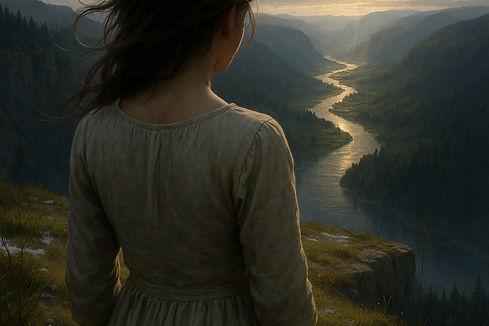
Atop a cliff carved by wind and time, where the earth gave way to sky, a girl stood on the precipice of oblivion.

Chapter: 1.1
Janna
Scene: 1.1.1
The Girl at the Edge

Janna

1.1
1.1.1
The Girl at the Edge

The Girl at the Edge
Janna
Of all enemies, none is crueler than the mind.
At the edge of oblivion—high upon the steepest cliff—stood a girl suspended between life and death.
Janna—hauntingly lovely, almost a woman at sixteen—stared at the bleeding horizon, her wide blue eyes long emptied of hope.
The soil crumbled beneath her bare toes, as though the earth itself urged her forward.
The year was 1399. The place: a jagged mount that loomed over Valtice, a sleepy border town tucked deep within the hills of southern Bohemia. Wenceslaus IV held the throne.
Spring had come shyly, not yet brave enough to thaw the stones—a tender bloom hesitant beneath winter’s lingering breath. The sky pressed low and gray; far below, the river churned with the violent melt of ice, and in the distance the clustered rooftops of the town seemed painted upon a dream.
And there she stood—alone—at the edge of all things.
“It is time,” she murmured into the cold.
Her breath fled her in ragged clouds, the words carried off by the wind. Yet it wasn’t the chill that stole her breath—it was the hollow ache that had settled where her heart once beat. Her pulse thundered in her ears like distant war drums. The wind, wild and merciless, tore at her woolen robe and undid her loose braids like a jealous lover—howling with the voices of a hundred ghosts, biting her skin, whispering promises of what the world had never given: tranquility, stillness, peace.
Then came the other voices—ones not borne by the wind but crawling from within. They slithered through the hollow corridors of her mind, speaking venom in a tongue only she could hear: the tongue of the forsaken.
“You were never meant to stay.”
“Your best days are already behind you.”
“Just one step.”
“Jump.”
How many times must we hear a lie before we believe it?
When facing the end, the mind tends to drift—always back to the beginning.
And suddenly she was a child again.
Not sixteen, but six.


Characters:


Go
Back

Saga
Next

1.1.2
VThe First
Codex

Characters

Timeline

Creatures

Places

The Divine

Myths & Truth
Go to

Home

Saga

AudioBook

Codex

Gallery
More

